
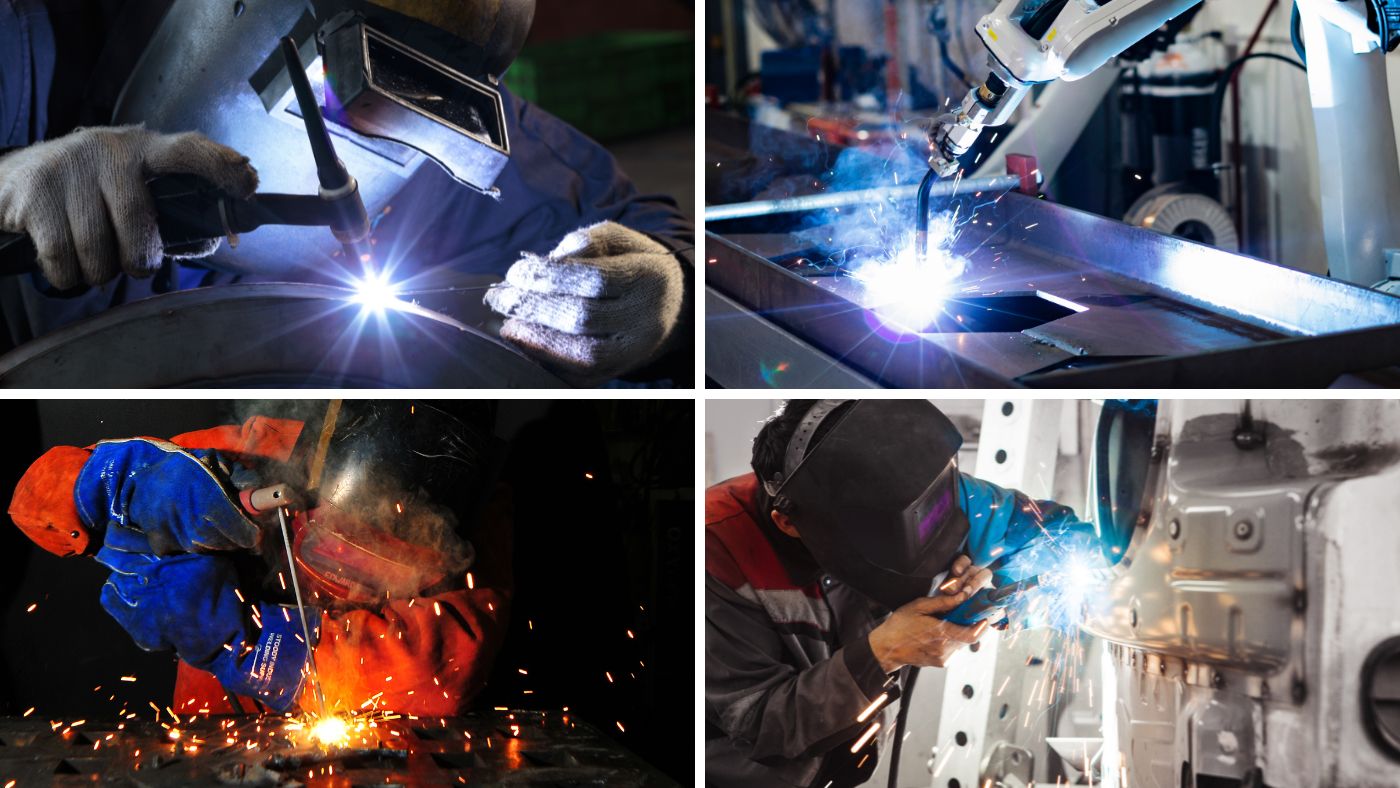
Types of Welding in Steel Structures
Welding plays a critical role in the construction of steel buildings and steel structures, ensuring their strength, durability, and integrity. In Vietnam, the steel fabrication industry employs various welding techniques to meet diverse project requirements. Understanding the different types of welding used in steel fabrication can help in choosing the best method for specific applications, ensuring the highest quality standards.
1. Shielded Metal Arc Welding (SMAW)
Shielded Metal Arc Welding (SMAW), also known as stick welding, is a widely used method in steel structures. This process utilizes a consumable electrode coated with flux, which melts during welding to form the weld joint.
Advantages:
- Versatile and straightforward
- Suitable for outdoor and windy conditions
- Effective on a variety of materials and thicknesses
Applications:
- Structural steel fabrication
- Repair and maintenance work
2. Gas Metal Arc Welding (GMAW)
Gas Metal Arc Welding (GMAW), commonly known as MIG welding, employs a continuous wire electrode and a shielding gas to protect the weld pool from contamination. This method is favored for its efficiency and clean welds.
Advantages:
- High welding speed
- Minimal post-weld cleaning
- Suitable for thin to medium-thickness metals
Applications:
- Steel buildings
- Automotive industry
- General steel fabrication in Vietnam
3. Flux-Cored Arc Welding (FCAW)
Flux-Cored Arc Welding (FCAW) is similar to GMAW but uses a tubular wire filled with flux. This technique can be performed with or without an external shielding gas, making it versatile for various conditions.
Advantages:
- High deposition rate
- Suitable for thick sections and heavy-duty applications
- Effective in outdoor and windy environments
Applications:
- Heavy machinery and equipment
- Shipbuilding
- Structural steel projects
4. Gas Tungsten Arc Welding (GTAW)
Gas Tungsten Arc Welding (GTAW), also known as TIG welding, uses a non-consumable tungsten electrode and a shielding gas. This method is renowned for producing high-quality, precise welds.
Advantages:
- High-quality welds with minimal spatter
- Suitable for thin materials and critical joints
- Excellent control over the weld
Applications:
- Aerospace and aviation
- Piping and tubing
- High-quality steel structures
5. Submerged Arc Welding (SAW)
Submerged Arc Welding (SAW) employs a continuous wire electrode and a granular flux that covers the weld pool. This method is highly automated, providing deep weld penetration and high deposition rates.
Advantages:
- High deposition rates
- Deep weld penetration
- Minimal exposure to welding fumes
Applications:
- Large-scale structural steel fabrication
- Pressure vessels
- Bridges and infrastructure projects
6. Spot Welding
Spot Welding is a resistance welding technique used to join overlapping sheets of metal. This method uses the heat generated by electrical resistance to form the weld.
Advantages:
- Fast and efficient
- Suitable for joining thin metal sheets
- Minimal distortion
Applications:
- Automotive industry
- Steel sheet fabrication
- Lightweight steel structures
Conclusion
The choice of welding technique is crucial in ensuring the success of steel buildings and steel structures. In Vietnam, the steel fabrication industry leverages various welding methods to cater to different project needs, ensuring robust and durable constructions. Whether it is the versatility of SMAW, the efficiency of GMAW, or the precision of GTAW, each method has its unique benefits and applications.
By understanding these different welding techniques, stakeholders in the steel fabrication industry can make informed decisions, ensuring the highest quality in their projects. This comprehensive knowledge not only enhances the structural integrity of steel buildings but also promotes the growth and competitiveness of steel fabrication in Vietnam.